AI Guesses the Future
The "Maybe" Machine: How AI Guesses the Future
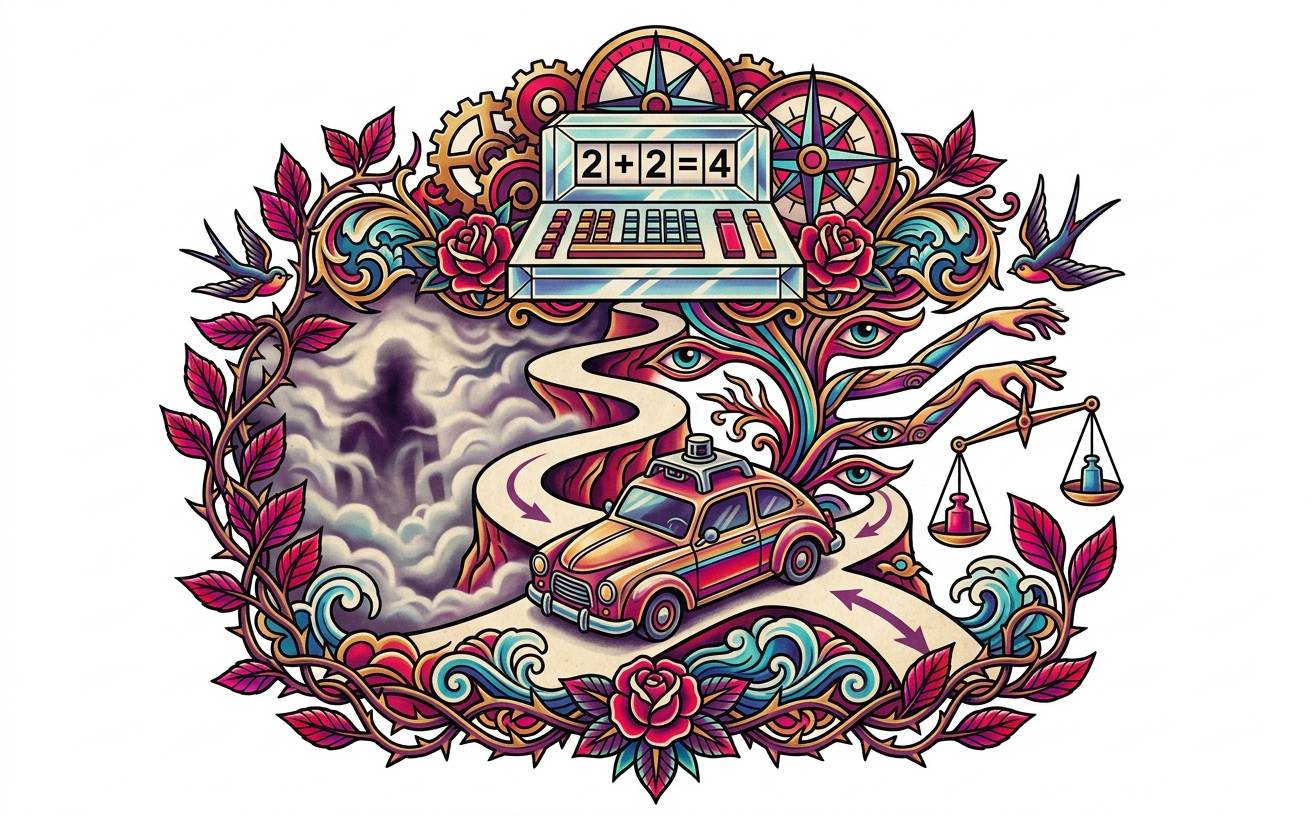
When we think of computers, we usually think of absolute certainty. A calculator doesn’t "guess" that 2+2 is 4; it knows it. But the real world is messy. If a self-driving car sees a blurry shape in the fog, it can’t afford to wait until it’s 100% sure what it is. It has to make a move based on a "maybe."
This is where the "Artificial" part of AI meets the "Intelligence" part: Probability. Here is the breakdown of how AI deals with a world that isn't always black and white.
The Basics: Possible Worlds
In probability, we think in terms of "possible worlds." If you roll a six-sided die, there are six possible worlds. In one world, you rolled a 1; in another, a 2, and so on.
AI assigns a number to these worlds between 0 (impossible) and 1 (totally certain). The most important rule? If you add up the probabilities of every possible world in a situation, the sum must equal 1. It’s like a pie—you can cut it into as many slices as you want, but you’ll always have one whole pie.
The "Given" Rule (Conditional Probability)
This is the heart of AI logic. It’s called conditional probability. It’s the chance that one thing is true, given that we already know something else is true.
Think about it: What’s the chance of rain today? Just guessing off the top of your head is "unconditional probability." But what’s the chance of rain given that you look outside and see giant, dark clouds? That’s "conditional probability." The evidence (the clouds) changes the likelihood of the result (the rain). AI uses this to update its "beliefs" as it gathers new data.
Bayes’ Rule: The Ultimate Flip
Sometimes, it’s easy to know the probability of an "Effect" given a "Cause," but hard to know the "Cause" given the "Effect."
For example, doctors know the probability that a medical test will come back positive if a patient has a certain disease. But a patient wants to know the opposite: What is the probability I have the disease if my test came back positive? A math trick called Bayes’ Rule allows the AI to flip that information around to give the patient the answer they actually need.
Bayesian Networks: Mapping the Domino Effect
In real life, things are rarely a simple 1-to-1 relationship. One event usually triggers another. To handle this, AI researchers build Bayesian Networks.
Imagine a map of nodes connected by arrows. "Rain" might have an arrow pointing to "Train Delay," and "Train Delay" points to "Missing My Appointment." By looking at this network, an AI can calculate the odds of you missing your meeting just by looking at the weather forecast. It’s a way of organizing complicated "maybe" situations so a computer can digest them.
Sampling: The "Shortcut"
Sometimes, the math in a Bayesian Network becomes so incredibly hard that even a supercomputer would take years to solve it. When that happens, the AI takes a shortcut called Sampling.
Instead of doing the exact math, the AI runs a simulation—thousands or millions of times. It "rolls the dice" for every variable in its map and records what happens. If the AI simulates a "world" 10,000 times and you miss your meeting in 2,000 of those simulations, it concludes there is a 20% chance of you being late. It’s an approximation, but it’s usually "close enough" for the AI to make a smart decision.
Predicting the Future (Markov Chains)
How does your phone know what word you’re going to type next? It uses a Markov Model.
This model relies on the Markov Assumption, which says that to predict the future, you only need to know the current state. You don’t need to know the entire history of the world. If you just typed the word "How," the Markov Model knows there's a high probability the next word is "are" or "is." It doesn't care what you typed ten minutes ago; it only cares about what is happening right now.
Hidden Markov Models: Being a Detective
Finally, we have Hidden Markov Models (HMMs). This is how Alexa or Siri understands you.
The "Hidden" part is the actual word you said. The AI can't see your thoughts. All it can see is the "Observation"—the messy, noisy audio recording of your voice. The AI acts like a detective: it looks at the noisy audio and works backward using probability to guess the most likely "hidden" words that created that sound.