Software Development Costs Less than Minimum Wage
The $10 Software Developer: Why an 80s Computer Should Change How You Think About the Future
About a year ago, Geoffrey Huntley stumbled onto an old piece of 1980s technology called the Z80. It’s a tiny, ancient computer chip, but what he did with it should probably scare anyone planning a career in tech.
He took a modern computer program, stripped it down to its bare bones (assembly code), threw away the original files, and asked an AI to "guess" the blueprints. Then, he told the AI to take those blueprints and build a brand-new version of the app for that 40-year-old Z80 chip.
It worked.
This might sound like a boring science project, but it proved something world-changing: Software has no more secrets. If an AI can look at the "scraps" of a program and rebuild it perfectly, then no company’s product is safe from being cloned.
The "Clean Room" Trick
In the business world, companies have "moats"—big walls of lawyers and secret code that protect them from competitors. If you wanted to copy a big company like HashiCorp, you’d usually need hundreds of millions of dollars and thousands of developers.
But using AI, you can do a "clean room" design. You have the AI reverse-engineer the product to create a set of instructions (specifications), and then you have a fresh AI build a new version based on those instructions. It’s a legal way to "clone" a company. Suddenly, two people sitting on a beach in Bali can compete with a corporation of 5,000 people.
Meet "Ralph": The AI That Never Sleeps
The secret weapon in this story is something called Ralph. Ralph isn't a person; it’s a loop.
Think about how you use ChatGPT. You ask a question, it gives an answer, and you're done. That’s a "consumer" mindset. But what if you put the AI in a hamster wheel?
Huntley’s 9-year-old son actually came up with the idea while they were playing a video game called Factorio. He noticed his dad doing the same tasks over and over and said, "Why don't you just put it in a loop?"
That’s what an AI Agent is. You give the AI "tools"—the ability to read files, write code, and run programs. Then you give it a goal. The AI writes some code, hits an error, reads the error itself, fixes the mistake, and tries again. It keeps looping until the job is done. It’s like a digital worker that never gets tired, never complains, and never stops until the code is perfect.
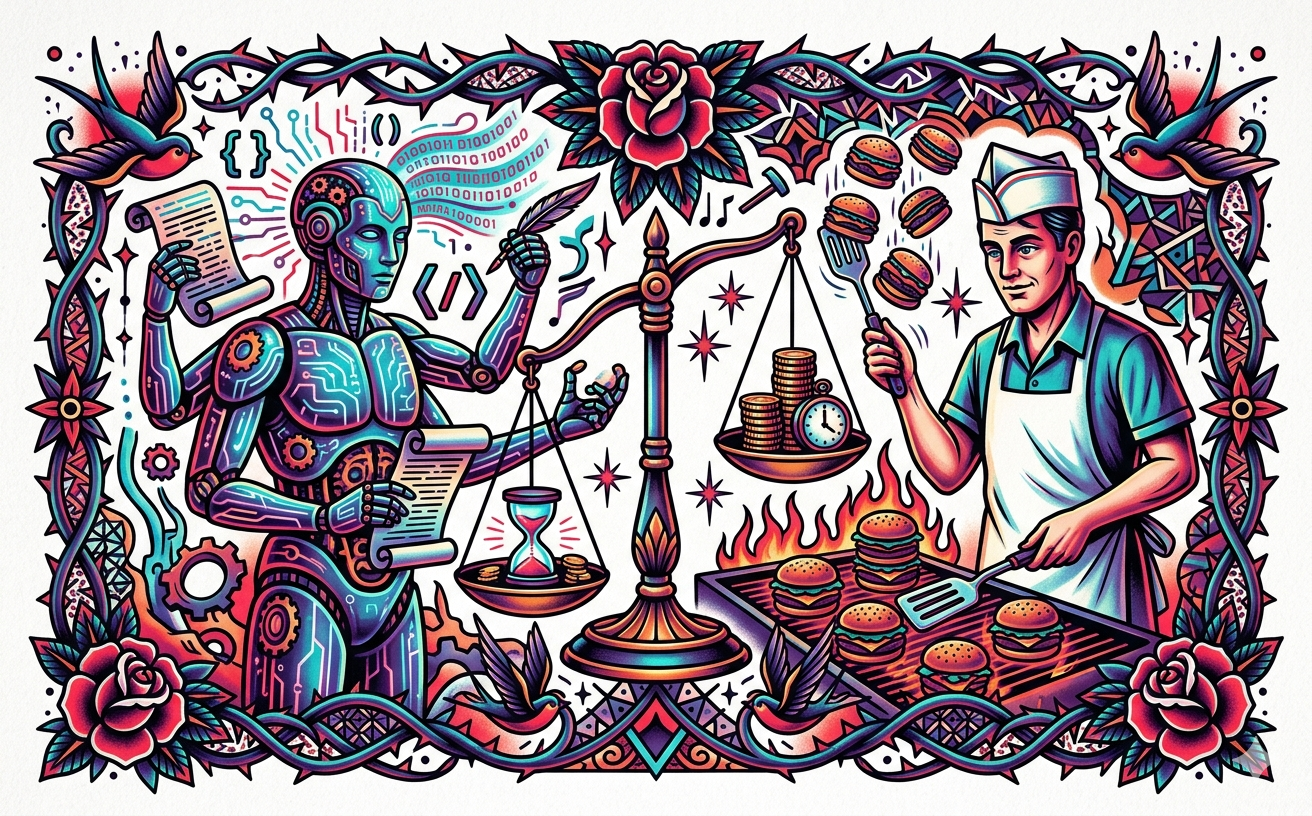
The "Burger Flipper" Economics
Here is the "ouch" moment: Running one of these high-end AI loops costs about $10.42 an hour.
Think about that. In many places, that is cheaper than the minimum wage for flipping burgers. If an AI can do the work of a professional software developer for less than the cost of a McDonald’s worker, the world of work has changed forever.
Huntley calls this "disruptive innovation." The "old world" involves massive offices full of people typing away. The "new world" involves a few people who know how to manage these AI loops.
The Line in the Sand
There is a "line" being drawn in the tech industry right now.
On one side: People who use AI as a toy or a shortcut for homework.
On the other side: "AI-first" builders. These are people who understand the "mechanics." They know how to build the loops, how the "brain" of the AI connects to the computer, and how to automate entire jobs.
The scary part? A cohort of juniors—people just a few years older than you—have been practicing this for a year already. They have a massive head start. If you’re waiting for the "models to get better" before you start learning, you’re already losing the race.
What Should You Do?
The message isn't that "coding is dead." It’s that being a "consumer" is dangerous.
If you want a spot on the "lifeboat," you have to become a builder. You don't just need to know how to code; you need to know how to build an agent. You need to understand the "inferencing loop"—the way an AI thinks and acts in a cycle.
The software industry is having its "shipping container" moment. Before the metal shipping container, people carried crates onto ships by hand. Once the box arrived, those jobs vanished, and the world changed. The "box" for software has arrived. The question is: Are you going to be the person carrying the crates, or the person running the crane?
The opportunity of a lifetime is right now. Go build something.