A Deep Dive into AI Search
How Computers Find the Way: A Deep Dive into AI Search
Ever wonder how Google Maps finds the fastest route to Taco Bell in three seconds, or how a computer can absolutely crush you at Tic-Tac-Toe? It’s not magic; it’s a field of Artificial Intelligence called Search.
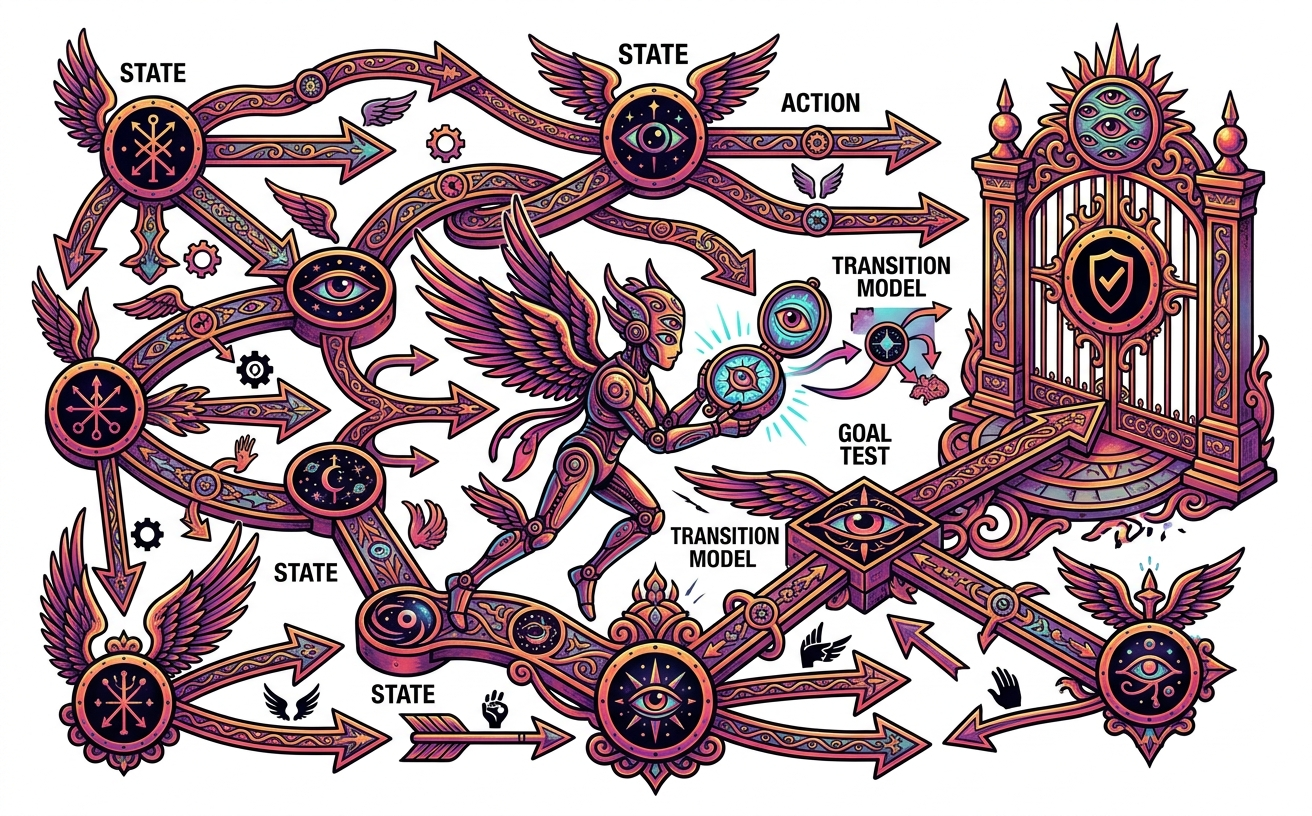
At its heart, search is about an agent (the AI) navigating through an environment. To do this, the AI needs to understand states (where it is right now) and actions (where it can go next). By using a transition model, the AI calculates what happens after a move, and it uses a goal test to see if it finally reached the finish line.
But how does it actually "think" through the options? Let’s look at the secret strategies computers use to solve problems.
The "Blind" Searchers: DFS and BFS
Imagine you’re in a dark maze with only a flashlight. You have two main ways to explore:
Depth-First Search (DFS): This is the "Deep Diver" approach. You pick a path and follow it as far as it goes until you hit a dead end. Then you backtrack and try the next branch.
The Good: It doesn't need to remember much (low memory).
The Bad: It might find a super long, confusing path to the exit while a shorter one was right at the start. It’s not "optimal."
Breadth-First Search (BFS): This is the "Social Butterfly" approach. You look at every path one step away, then every path two steps away, and so on.
The Good: It is guaranteed to find the shortest path.
The Bad: It has to remember every single path it’s looking at, which can crash a computer if the maze is too big.
Working Smarter: Informed Search
"Blind" searches are okay for small puzzles, but Google Maps doesn't look at every street in the country to find your house. It uses Informed Search, which basically means it has a "hint."
This hint is called a heuristic. A common heuristic is the Manhattan Distance—calculating how many squares away the goal is in a straight line, ignoring the walls.
Greedy Best-First Search: This algorithm always picks the path that looks closest to the goal based on the hint. It’s fast, but like a person who tries to take a shortcut and gets stuck in a swamp, it can sometimes pick a path that turns out to be longer.
A Search:* This is the gold standard. It looks at the cost it took to get to a spot plus the heuristic hint. By balancing where it’s been with where it’s going, A* is guaranteed to find the best path every time, as long as its "hint" never overestimates the distance.
Playing for Keeps: Adversarial Search
What happens when someone is fighting back? In games like Tic-Tac-Toe or Chess, the AI uses Minimax.
In Minimax, there are two players: Max (the AI, trying to get the highest score) and Min (the opponent, trying to keep the AI's score low). The AI literally plays the entire game out in its head. It assumes you are smart and will always make the move that hurts it the most. It then picks the move where, even if you play perfectly, the AI still gets the best possible result.
For massive games like Chess, the computer can't see all the way to the end (there are more possible chess games than atoms in the universe!). So, it uses two tricks:
Alpha-Beta Pruning: It stops looking at a move the moment it realizes that move is worse than one it already found. It’s like saying, "I won't check the basement for snacks because I already found a pizza in the kitchen."
Depth-Limiting: It only looks maybe 10 or 20 moves ahead and then uses an evaluation function to guess who is winning based on how many pieces are left.
Why It Matters
Search is the foundation of AI. Whether it’s a robot vacuum finding its way around your couch or a computer-controlled character in a video game trying to flank you, these algorithms are the "brains" making it happen. By turning the world into math and states, computers can solve problems that would take humans a lifetime to figure out.